Water Softening and Boiler Feed Water
The hardness of water is caused by the cations and the balancing anions. In general, hard water is found in areas with abundant limestone and dense topsoil, whereas soft water is more common in regions with loose, non-calcareous soils. The hardness of water does not seriously affect human health. However, hard water increases the consumption of soap and detergents in cleaning and maintenance.
* Classification of Water Hardness
Water hardness can vary by region depending on the local geological structure. Groundwater is generally harder than surface water. Water hardness typically ranges from 10 ppm CaCO3 to 1800 ppm CaCO3.
* Degrees of Water Hardness
- 0-75 ppm CaCO3: soft to slightly hard
- 76-150 ppm CaCO3: moderately hard
- 151-300 ppm CaCO3: hard
- Above 300 ppm CaCO3: excessively hard
Although municipal (network) water hardness varies by region, it is generally lower, while well water tends to have higher hardness.
The use of soft water is important in many sectors. It is particularly valued for direct consumption purposes, and its importance in process applications—such as in steam boilers—is even more pronounced.
Steam Boiler Operating Principles and the Use of Soft Water
*Blowdown is the process of discharging a portion of boiler water to reduce the concentration of dissolved or suspended solids— which increases due to evaporation—within the limits set for the boiler. Boiler feed water is the water added to compensate for losses from blowdown and evaporation.
* Analysis Values for Determining the Conditioning of Boiler Feed Water
These values help determine whether the feed water is scaling, neutral, or corrosive:
- Conductivity: Measures the amount of dissolved ions. As water is purified, conductivity decreases (measured in µS/cm, the inverse of resistance).
- Total Dissolved Solids: Indicates the total amount of solids dissolved in the water.
- Suspended Solids: Particles that remain undissolved, causing turbidity and unwanted color. Such water should be filtered physically before being fed to the boiler; otherwise, it may lead to soft scale, loose sludge, and foaming.
- pH Value: Indicates the acidity or alkalinity of the water. pH values outside the acceptable range can cause acid or caustic corrosion and must be adjusted with acid or caustic additions.
- Alkalinity: Formed by hydroxide, carbonate, and bicarbonate, which contribute to the water's basicity. Very low or very high alkalinity can lead to foaming in the boiler, caustic embrittlement, and carbon dioxide corrosion in steam-condensate lines. Dealkalization brings the alkalinity into the desired range.
- Total Hardness: Measures the amount of dissolved calcium and magnesium salts (expressed as CaCO3). High hardness causes scale formation in the boiler; softening the water before it enters the boiler removes this hardness.
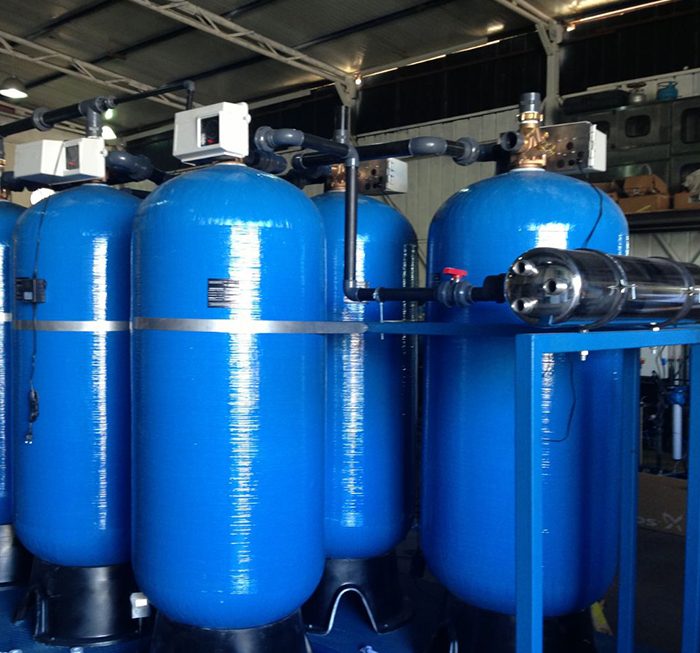
* The most commonly used water treatment system for boiler feed water is the softening system. Pre-conditioning of the feed water before entering the boiler is typically achieved through softening.
Pre-conditioning methods prepare the feed water before it enters the boiler. The most common off-boiler pre-conditioning process is softening. In many operations, raw well water with very high hardness is used. Such high hardness cannot be completely removed by chemical conditioning inside the boiler; therefore, the water should pass through a softening circuit to remove excess hardness.
It is possible to reduce the hardness of water processed by softening systems to 1°F (10 mg CaCO3/L). Occasionally, a slight hardness leakage may occur, which can be remedied by increasing the salt dosage during regeneration. If the resin becomes fouled and its softening capacity decreases, replacing the resin will restore the system’s original performance.
As detailed above, the use of a softening system in boiler feed water is critical. At KUZEY ARITMA, we offer design, sales, and after-sales support for softening and other treatment systems tailored to your needs. We provide solutions to ensure your boilers operate optimally and your production is not adversely affected, and we welcome your inquiries.