Cartridge Filter Systems
Cartridge Filter Systems
Cartridge Filters and Mechanical Filtration Systems
What Is a Cartridge Filter?
A cartridge filter is a mechanical filtration device used in water treatment systems to physically remove sediment, sand, rust, mud, suspended solids, and various particles from water. Widely used in domestic and industrial water treatment applications, cartridge filtration systems reduce the particulate load in water and help subsequent treatment stages operate more efficiently.
Cartridge filters play a particularly important role in protecting membranes against particle-related fouling in industrial reverse osmosis (RO) systems. They operate by passing water through filter elements with a specified micron rating.
Cartridge filtration systems are used in drinking water treatment plants, industrial process water preparation systems, food production facilities, chemical plants, pharmaceutical manufacturing, textile operations, and various industrial applications.
What Is Mechanical Filtration?
Mechanical filtration is a process that physically separates undissolved solid particles from water.
During mechanical filtration, water passes through a filter medium with a defined pore structure. Depending on the retention capacity and micron rating of the medium, particles are captured on the filter surface or within the depths of the filter material.
The main purpose of mechanical filtration is to improve the physical quality of water and reduce the adverse effects of particles on pumps, valves, membranes, and other equipment in a treatment system.
Mechanical filtration systems can operate according to different principles. Cartridge filters, bag filters, screen filters, and appropriately designed sand filters are examples of mechanical filtration applications.
How Does a Cartridge Filter Work?
A cartridge filter works by passing water through a cartridge element housed inside a filter vessel.
As incoming water passes through the filtration surface of the cartridge, particles of certain sizes are retained by the filter material. The filtered water then enters the clean-water collection area of the cartridge and flows toward the system outlet.
Particles accumulating on the cartridge during filtration gradually increase resistance to water flow. As a result, the pressure differential between the filter inlet and outlet increases.
For this reason, it is important to regularly monitor inlet and outlet pressures in cartridge filtration systems. Cartridge elements must be replaced when the specified differential pressure limit is reached or when the manufacturer's maintenance criteria are met.
Cartridge filter performance depends on the contaminant load, particle sizes, cartridge micron rating, filter material, water flow rate, and operating conditions.
What Are the Types of Cartridge Filters?
Various cartridge filters are used in industrial and domestic water treatment systems to meet different filtration requirements.
1. PP Spun Cartridge Filter
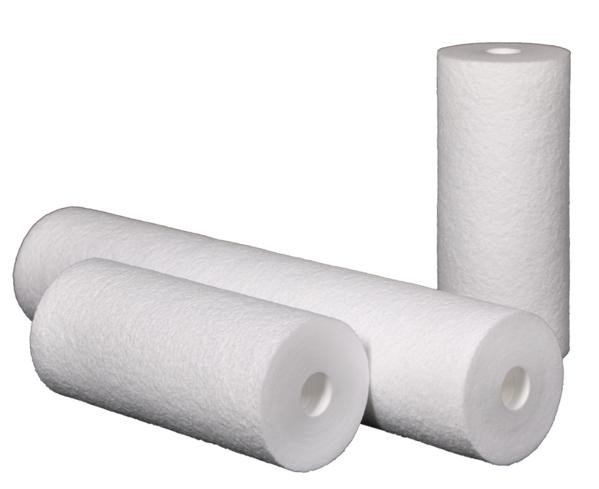
PP spun cartridge filters are made of polypropylene and operate on the principle of depth filtration.
Manufactured using the melt-blown process, these cartridges are widely used to capture sand, rust, sediment, and suspended solids in water.
PP spun cartridge filters are available in different micron ratings. In particular, 1-micron, 5-micron, 10-micron, 20-micron, and 50-micron options are frequently preferred in the water treatment industry.
Under suitable operating conditions, polypropylene cartridge filters provide economical and effective particle filtration.
2. String-Wound Cartridge Filter
String-wound cartridge filters are manufactured by winding filter yarn around a central core in a controlled manner.
Thanks to their porous wound structure, these filters can retain particles at different depths within the filter material.
String-wound filters are used in industrial process water, pretreatment systems, and various liquid filtration applications.
Their filtration performance depends on the yarn material, winding density, and manufacturing quality.
3. Pleated Cartridge Filter
Pleated cartridge filters are designed with folded filter media to provide a large filtration surface area.
The larger filtration area can provide high flow capacity and low initial pressure drop in appropriately designed systems.
Pleated filters are preferred for industrial water treatment, process water filtration, and applications requiring fine particle removal.
Some pleated cartridge filter models can be cleaned and reused using suitable cleaning procedures, while others are designed for single use.
4. Stainless Steel Cartridge Filter
Stainless steel cartridge filters use metallic filter elements and are designed for filtration applications requiring high mechanical strength.
With the appropriate material selection, stainless steel filter elements can be used at high temperatures and under different process conditions.
An important advantage of suitable models is that they can be cleaned and reused.
Cartridge Filter Micron Ratings
One of the most important technical characteristics when selecting a cartridge filter is its filtration rating.
Filtration rating is expressed in microns (µm). One micron equals one-thousandth of a millimeter.
Common cartridge filter micron ratings used in water treatment systems include:
- 1-micron cartridge filter: Used for fine particle retention and precision pretreatment applications.
- 5-micron cartridge filter: One of the commonly used pretreatment options in industrial reverse osmosis systems.
- 10-micron cartridge filter: Preferred for medium-precision sediment and particle filtration.
- 20-micron cartridge filter: Used for removing larger particles and in pretreatment stages.
- 50-micron cartridge filter: Used for coarse particle removal and pretreatment applications.
- 100-micron cartridge filter: Preferred for applications intended to retain larger solid particles.
When evaluating cartridge filter micron ratings, the difference between nominal and absolute filtration ratings must be considered.
A cartridge with a nominal micron rating does not necessarily capture every particle of the specified size. Actual filtration efficiency depends on the particle retention performance stated by the manufacturer.
Industrial Cartridge Filtration Systems
Industrial cartridge filtration systems are filtration equipment used for particle control in high-flow water treatment plants.
In industrial applications, cartridge filters are generally used with filter housings that accommodate multiple filter elements.
These systems can be designed with different cartridge quantities, connection sizes, housing materials, and operating pressures according to process requirements.
Correct sizing of industrial cartridge filtration systems is important for filtration performance and operating costs.
The following parameters should be evaluated during system design:
- Hourly water flow rate
- Inlet water quality
- Suspended solids concentration
- Required filtration rating
- Allowable flow rate per cartridge
- Filter housing operating pressure
- Allowable pressure drop
- Dirt-holding capacity of the cartridges
- Operating temperature
- Cartridge replacement and maintenance conditions
A properly selected industrial cartridge filtration system helps reduce particle-related equipment problems and supports more stable operation of the water treatment plant.
What Is a Cartridge Filter Housing?
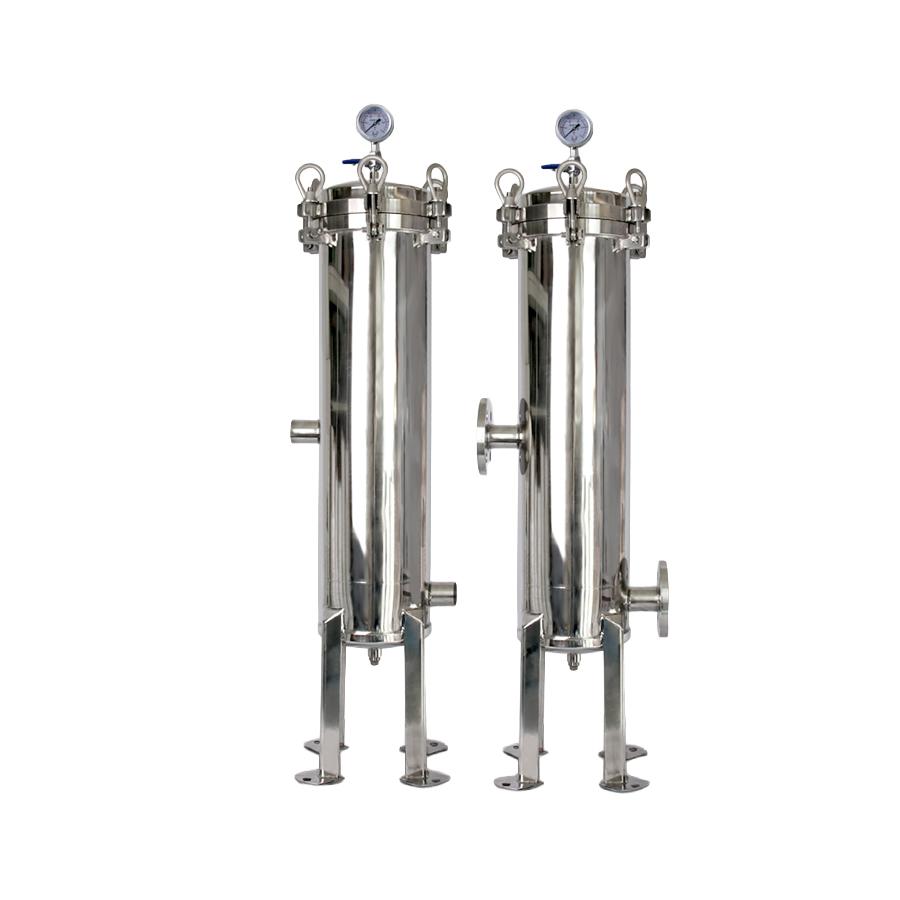
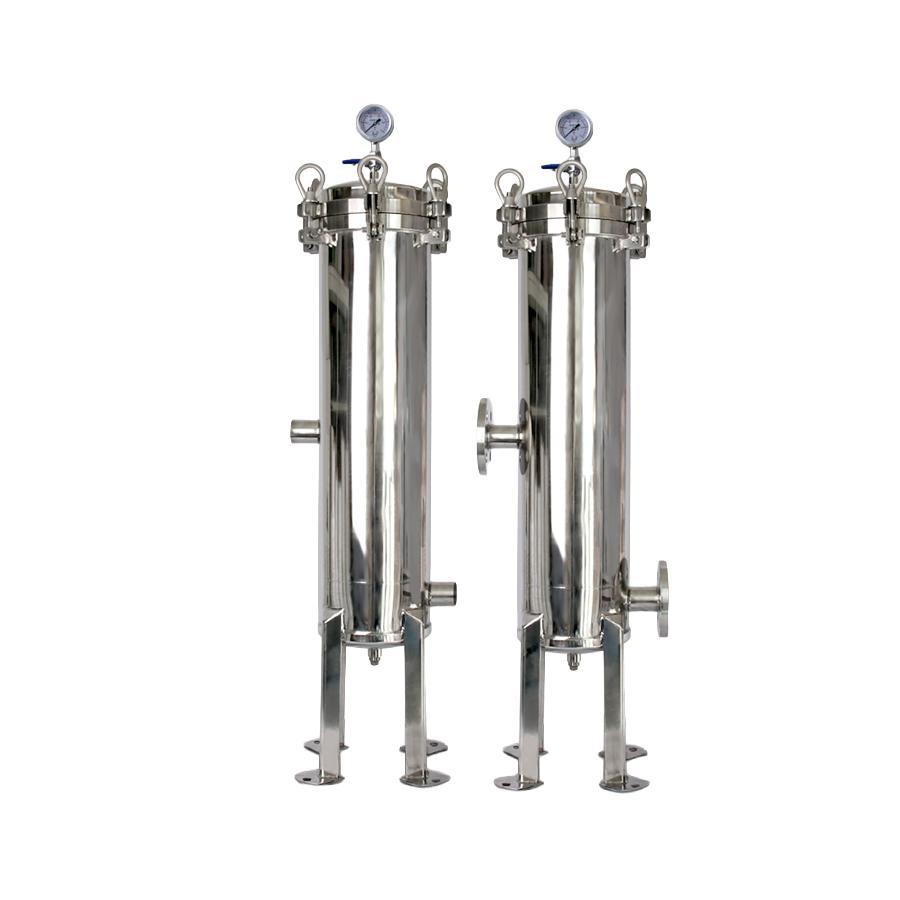
A cartridge filter housing is a pressure-rated filter vessel in which cartridge filter elements are installed to enable controlled water filtration.
Cartridge filter housing systems are manufactured with different specifications depending on cartridge dimensions and operating conditions.
Stainless steel, PVC, UPVC, polypropylene, and appropriately designed composite housings can be used in industrial water treatment applications.
Stainless steel cartridge filter housings are widely preferred due to their mechanical strength and suitability for industrial use.
Stainless Steel Cartridge Filter Housing
Stainless steel cartridge filter housings are used particularly in high-flow industrial water treatment systems.
Filter housings can be manufactured from AISI 304 and AISI 316L stainless steel, selected according to water quality and operating conditions.
When selecting a stainless steel cartridge filter housing, design pressure, connection dimensions, gasket material, and cartridge arrangement are as important as the housing material.
Cartridge Filter Dimensions
Cartridge filters are manufactured in various lengths and diameters.
Common standard cartridge lengths in the water treatment industry are 10 inches, 20 inches, 30 inches, and 40 inches.
In addition to standard-diameter cartridges, wide-diameter Big Blue cartridges and specialized high-flow cartridge filter models are also available.
As cartridge length increases, the filtration surface area and, under suitable conditions, the flow capacity may increase. However, actual capacity cannot be determined by cartridge length alone.
Cartridge material, micron rating, filtration area, and the manufacturer's hydraulic performance data must also be considered.
Use of Cartridge Filters in Reverse Osmosis Systems
Reverse osmosis systems are water treatment systems that use high-precision membrane technology.
For RO membranes to operate efficiently and achieve a long service life, feedwater must undergo appropriate pretreatment.
In reverse osmosis systems, cartridge filters are generally used as one of the final particle filtration stages before the high-pressure pump.
By reducing sediment, sand, rust, and other particles that may remain in pretreated water, cartridge filters lower the risk of particle accumulation in membrane feed channels.
5-micron cartridge filters are commonly used in industrial reverse osmosis systems. However, whether the cartridge has a nominal or absolute filtration rating, the membrane manufacturer's pretreatment requirements, and the raw water quality must all be considered.
Cartridge filters alone cannot remove dissolved salts, hardness ions, or all colloidal contaminants. Therefore, RO pretreatment must be designed as an integrated process based on water analysis.
How Is Cartridge Filter Flow Capacity Calculated?
The capacity of a cartridge filtration system is calculated based on the total water flow rate and the operating flow rates specified by the cartridge manufacturer.
For example, consider a water treatment system with a capacity of 20 m³/h, where the selected cartridge is assumed to have a suitable design flow rate of 2.5 m³/h.
The required number of cartridges is calculated as follows:
Number of cartridges = Total system flow rate / Design flow rate per cartridge
20 / 2.5 = 8 cartridges
In this example, 8 cartridges are required.
However, actual system design must also consider cartridge fouling allowance, initial pressure drop, the hydraulic characteristics of the filter housing, and operating conditions.
The allowable flow rate per cartridge is not the same for every product. Therefore, the manufacturer's technical data must be used for accurate engineering calculations.
Cartridge Filter Pressure Drop
Pressure drop in cartridge filters refers to the pressure difference between the filter inlet and outlet.
As particles accumulate on the filter element, resistance to water flow increases. Consequently, the differential pressure rises.
Monitoring the pressure differential in cartridge filtration systems is an important method for determining when filter elements should be replaced.
The maximum differential pressure permitted before cartridge replacement must be determined according to the cartridge's technical specifications and system operating conditions.
Exceeding the allowable pressure differential may damage the filter element, reduce system flow, or adversely affect filtration performance.
When Should a Cartridge Filter Be Replaced?
Cartridge filter replacement intervals depend on the contaminant load in the water and the system's operating conditions.
In water containing high levels of sediment and suspended solids, cartridge filters may become clogged more quickly.
In systems with effective pretreatment, cartridge service life may be longer.
The following criteria should be evaluated to determine when cartridge filters need replacement:
- An increase in the pressure differential between the filter inlet and outlet
- A decrease in system flow rate
- Approaching the manufacturer's maximum specified differential pressure
- Deformation of the filter element
- Hygiene and periodic maintenance requirements of the facility
Timely cartridge filter replacement is important for maintaining system performance.
Difference Between Cartridge Filters and Sand Filters
Cartridge filters and sand filters are two different mechanical filtration systems used to remove particles from water.
Sand filters perform filtration through a granular filter bed. In properly designed systems, particles accumulated in the filter bed can be removed by backwashing.
Cartridge filters, on the other hand, use replaceable filter elements or, in certain models, elements that can be cleaned.
For water with a high particle load, using a sand filter or multimedia filter can help prevent cartridge filters in subsequent stages from clogging too quickly.
In industrial reverse osmosis applications, sand filters and cartridge filters are not necessarily alternatives to each other; in suitable projects, they serve as complementary filtration equipment.
Applications of Cartridge Filters
Cartridge filtration systems are used in different industries to control particulate water quality.
Main application areas include:
- Industrial water treatment plants
- Reverse osmosis water treatment systems
- Drinking water preparation systems
- Food and beverage production facilities
- Pharmaceutical and cosmetics manufacturing facilities
- Textile industry
- Chemical industry
- Power generation facilities
- Cooling water systems
- Process water preparation systems
- Well water treatment systems
- Domestic water purifiers
The appropriate cartridge material, filtration rating, and housing specifications must be evaluated separately for each application.
What Should Be Considered When Choosing a Cartridge Filter?
Correct cartridge filter selection directly affects filtration performance as well as operating costs.
A cartridge filter should not be selected solely based on its price or micron rating.
First, the physical and chemical characteristics of the water to be filtered must be determined.
Then, the system's hourly flow rate, operating pressure, temperature, and required filtration rating should be evaluated.
The chemical compatibility of the cartridge material with the water, the pressure rating of the filter housing, and ease of cartridge replacement are also important selection criteria.
Improperly sized cartridge filtration systems can cause excessive pressure drop, frequent cartridge replacement, and unnecessary operating costs.
Advantages of Cartridge Filtration Systems
Cartridge filtration systems offer significant advantages in water treatment applications thanks to their compact design and availability in different filtration ratings.
Main advantages include:
- Filtration at different micron ratings
- Compact and modular system design
- Easy installation and maintenance
- Housing options suitable for different flow rates
- Protection of RO membranes against particle-related fouling
- Adaptability to various industrial processes
- Low initial pressure drop with proper design
- Convenient operation with replaceable filter elements
Professional Solutions for Cartridge Filters and Mechanical Filtration Systems
At Kuzey Arıtma Mühendislik, we provide solutions for cartridge filters, mechanical filters, filter housings, and pretreatment equipment for domestic and industrial water treatment applications.
We understand the importance of proper filter selection for system performance and operating costs in industrial water treatment systems.
We support businesses in identifying cartridge filtration and mechanical filtration solutions suitable for their water flow rates, water quality, filtration ratings, and process requirements.
You can contact our company for assistance in selecting suitable filtration equipment for reverse osmosis systems, industrial process water preparation plants, and various water treatment applications.
For cartridge filter prices, industrial cartridge filter housing options, mechanical filtration systems, and technical product information, contact Kuzey Arıtma Mühendislik to learn more about solutions tailored to your needs.
Frequently Asked Questions About Cartridge Filters
What does a cartridge filter do?
A cartridge filter is a mechanical filtration element that retains sand, rust, sediment, and suspended solids in water at a specified micron rating.
What does a 5-micron cartridge filter mean?
A 5-micron cartridge filter is a filter element that provides particle retention performance at approximately the 5-micron level according to the manufacturer's specified filtration rating. Actual retention efficiency depends on whether the rating is nominal or absolute.
Does a cartridge filter remove water hardness?
No. Standard sediment cartridge filters do not remove dissolved calcium and magnesium ions from water. Appropriate water softening, membrane, or other treatment technologies are required to reduce water hardness.
Does a cartridge filter remove iron and manganese?
Cartridge filters can retain particulate iron and manganese compounds if the particles are of suitable size. However, removing dissolved iron and manganese generally requires oxidation and appropriate filtration processes.
What micron rating should a cartridge filter have?
The appropriate micron rating depends on water quality and the intended application. Although 5-micron cartridge filters are common in industrial RO systems, the final selection should follow the membrane manufacturer's requirements.
How often should a cartridge filter be replaced?
There is no fixed cartridge filter replacement interval. It depends on water quality, operating flow rate, particle concentration, pressure differential, and the manufacturer's maintenance criteria.
What determines cartridge filter prices?
Cartridge filter prices may vary depending on filter material, micron rating, cartridge length, diameter, filtration area, manufacturing quality, and order quantity.
Are mechanical filters and cartridge filters the same?
A cartridge filter is one type of mechanical filtration. However, not all mechanical filters are cartridge filters. Sand filters, screen filters, and bag filters can also be used for mechanical filtration.
Does a cartridge filter protect a reverse osmosis membrane?
Yes. Properly selected cartridge filters help reduce the amount of particles reaching RO membranes, thereby lowering the risk of particle-related fouling. However, they are not sufficient on their own to protect membranes against every type of fouling.